Platform holds · Cash flow
Payout reserves and holds: when the money is actually released
A reserve is the slice of your own revenue a platform has collected from buyers and decided not to hand over yet. Most sellers understand the why within a week. What keeps costing them is the machinery: how the hold is structured, what quietly draws it down before the end date, and what happens on the day the period finally runs out.
Two sellers compare screenshots. One runs Shopify Payments and is staring at a line called Reserved funds. The other runs Stripe and has just read, on Stripe's own support page, that the company uses two types of reserve: fixed and rolling. The second seller asks the first whether hers is rolling. There is no honest answer available, because the page that governs her hold does not slice reserves along that axis at all.
That mismatch is where most reserve advice falls apart. Why reserves exist and what tied-up cash costs you is covered in our settlement costs pillar; why a brand-new account attracts one, and how to graduate out of it, sits in the channels guide. Everything below stays close to what the two platforms that publish real detail have actually published.
This page handles the other half: the mechanism, and the release.
The same word, cut two different ways
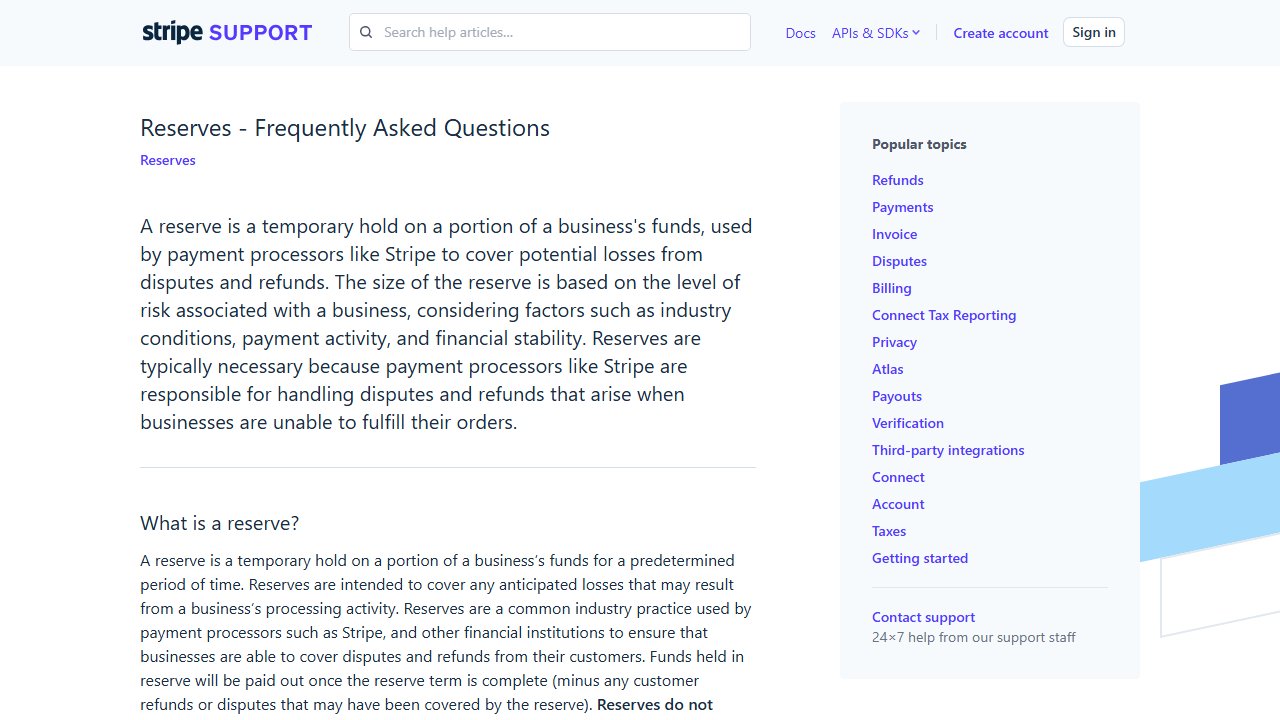
Stripe's reserves FAQ opens with a sentence worth reading twice: the company "uses two different types of reserves: fixed and rolling." The page names the pair and stops there. It does not define either term, so this guide will not define them for you either. A definition we invented would look, on your screen, exactly like one Stripe published, and you would plan around it.
Shopify Payments cuts the same idea along a different axis. Its help page on reserves describes a fixed amount reserve, which "involves setting aside a specific sum for a defined duration", and a percentage-based reserve, which "withholds a certain percentage of transactions for a specified period". The words rolling, minimum and up-front appear nowhere on it.
Put the two side by side and the shape emerges. Stripe's published split is about the time structure of the hold; Shopify's is about how the withheld figure gets calculated. A seller who learned the vocabulary on one platform then asks the other's support team a question its documentation has no field for, gets a woolly answer, and concludes the agent is hiding something.
About the numbers on that Shopify page
Shopify's page illustrates both types with figures: a fixed sum of $1,000, a rate of 10%, a duration of 120 days. Read the sentences around them. Each is introduced as an example — "for instance", "for example" — never as a default or a typical case, though seller forums quote them as "Shopify's standard reserve" anyway. Budget against whatever your own account page shows on the day you look.
A refund does not wait for the end date
Sellers picture a reserve as a sealed box that opens on a date. Stripe's FAQ describes something closer to a working fund: "If a transaction gets refunded or disputed, its corresponding reserve will be released and used to cover the refund/dispute immediately."
The hold therefore attaches to specific transactions, each slice carrying a job with it, and your reserved figure can fall without a cent of it reaching you — the money left, it just left in the direction of a customer.
Expiry is not arrival
Here is the sequence that wrecks cash-flow plans. Three separate conditions sit between the end of a reserve period and money in your bank, and only the first is widely understood.
What sits between the end date and your account
- Release is conditional, and it covers a remainder. Shopify: "At the end of the reserve period, the remaining reserve funds that are no longer required to address future refunds or disputes are returned in full." Stripe: "Reserve funds will be released in full at the end of the reserve period if they are not needed to cover disputes or refunds." Both say in full. Both attach it to what is left over.
- The period can be extended. Shopify's wording is that the reserve amount joins upcoming payouts "when you reach the reserve expiry date, and if no extension is required". That conditional clause is the platform telling you in passing that extensions exist. Shopify does say who decides — "Each reserve has an expiry date, and a risk assessment decides whether to lift, maintain, reduce, or increase the reserve." What that assessment weighs is not published on either page.
- Then it queues. Shopify again: "It might take several business days for the reserved funds to be processed for payout." The released money is included in upcoming payouts and moves at that payout's speed.
For anyone funding stock or ad spend out of expected cash, that stack of conditions turns a date into a hope. The planning rule holds up well here: money under reserve is money you have not been paid, and the day it clears sits somewhere inside a range of days.
Where to look, and what the field is called
On Shopify Payments, the payouts page carries two balances that sellers routinely read as one. Payout balance is defined there as "funds that have been captured but not yet added to a scheduled payout, not including reserved funds." Reserved funds is "money that's temporarily held and that can't be accessed until the reserve period ends." The exclusion buried in that first definition is the useful half: whatever your payout balance says, the reserve has already been taken out of it.
On Stripe, the reserve has no page of its own. The FAQ says its status is viewable on the Balance page of the Dashboard, in a pane labelled Reserve at the bottom of that page, below the balances you normally check.
What a reserve does to a cross-border plan
If you are selling from Jakarta, São Paulo or Lagos, the reserve sits upstream of every step this site covers. Nothing can be repatriated or converted while the platform is still holding it, so the hold shifts the start of your chain, not only its end.
It moves your FX date along with your cash date. If you convert deliberately rather than by default — the approach in our note on holding several currencies after payout — a released tranche still lands on a day the platform picked, at whatever rate that day happens to carry. Across a year of reserved slices, that is one more reason the effective rate you calculate never quite matches the rate you thought you agreed to, which our settlement costs pillar takes apart.
How to carry reserved cash in a plan is set out in the section on tied-up cash. One habit belongs here: when a reserve first appears, check whether anything else on the account is under review; reserves and compliance holds get mistaken for each other constantly, and they call for different responses, which our freeze playbook covers.
What the documentation does not say
We drafted a table for this page — reserve type, typical percentage and typical duration per platform — and deleted it. Every figure we could stand behind came from Stripe's and Shopify's own pages; the rest of what we found traced back to a forum thread, or to a blog quoting a forum thread, and we were not willing to pass that on as policy. A table like that reads as authoritative precisely because it is tidy.
So here is the honest inventory of what the two reserve pages leave unanswered, as checked in September 2026:
- Closing the account or switching providers. What becomes of an existing reserve when the relationship ends is not addressed on either page.
- The currency the reserve is held in, and how that interacts with selling or settling in more than one currency.
- Every other platform. If your hold is on PayPal, Etsy or Amazon, this guide does not tell you how that platform structures or ends it. Those platforms set out their own reserve terms in their help centres and account agreements, and this edition was checked against Stripe's and Shopify's pages only. Read yours at the source rather than assuming that anything above transfers to it.
Two questions worth putting in a support ticket
Documentation answers general questions. Yours is specific, so ask it in writing, inside the platform's own support channel:
1. Which type of reserve is on my account, in your own terminology, and what end date is currently recorded against it?
2. If refunds or disputes draw on the reserve before that date, does the held amount or the end date change as a result?
Keep the dated reply. A written answer about your own account is worth more to your accountant than any page on the internet, this one included.
Nobody can release your reserve for a fee
Reserve terms are set by the platform and handled inside its own support channels. Anyone offering to lift a reserve early, unlock a held balance for a commission, or do it faster if you hand over your login or a code sent to your phone is running a scam. Nothing here is financial, legal or tax advice; confirm your own position with your platform and your accountant.
FAQ
Is my reserve a rolling reserve?
That depends on whose dashboard you are looking at. Stripe's reserves FAQ says the company uses two types, fixed and rolling. Shopify's reserves page names a fixed amount reserve and a percentage-based reserve, and does not use the word rolling at all. If your hold is on Shopify Payments, the question has no field to land in, so ask support to describe the type in the platform's own terminology instead.
My reserve period ended, so where is the money?
Several things can explain it. Part of the reserve may already have gone to cover refunds or disputes, since what is returned is the remaining amount that is no longer required. The period may have been extended, which Shopify's page acknowledges by releasing funds only if no extension is required. And the released amount is included in upcoming payouts rather than sent separately, which Shopify notes might take several business days to process.
Can a refund draw on the reserve before the period ends?
On Stripe, yes. Its reserves FAQ states that if a transaction gets refunded or disputed, its corresponding reserve is released and used to cover the refund or dispute immediately. So the reserved figure on screen can fall without any of it reaching you.
Where do I actually see my reserve in the dashboard?
On Shopify Payments, the payouts page shows Reserved funds, described as money temporarily held that cannot be accessed until the reserve period ends, alongside a Payout balance that is explicitly defined as not including reserved funds. On Stripe, the status of a reserve is viewable on the Balance page of the Dashboard, in a Reserve pane at the bottom of that page.
Source check
Every quotation above comes from two published pages, both read in September 2026: Shopify Help Center — reserves on Shopify Payments payouts and Stripe support — reserves FAQ. Platform documentation changes without notice and terms differ by account, so open the page for your own platform before planning around anything here. Figures shown in those pages' examples are examples, not defaults.
Keep reading
Section: How Platforms Pay Out